

This post is also available in:
 ไทย (Thai)
Ask any executive what they want, and you’ll hear the same thing: “We need a more innovative culture.” Ask them what they’re doing about it, and you’ll hear about open-plan offices, free snacks, and maybe a new foosball table.
These perks are not a culture. They are decorations. This is not just a theory about making people feel good; it’s a core driver of financial performance. Decades of research from Gallup have shown that business units in the top quartile for employee engagement—a direct result of a strong, supportive culture—achieve, on average, 23% higher profitability and 18% higher productivity than their peers. A great culture is a powerful competitive advantage.
A true culture of innovation has little to do with the office environment. It’s about what happens in people’s minds. It’s about what they believe, how they think, and what they feel is possible. As a leader, your most important job is not to change your office, but to create the conditions for your team to change their mindset.
But how do you change something as deeply ingrained as a mindset? You need a map. One of the most powerful frameworks for this challenge is the Logical Levels of Change, developed by the pioneering NLP coach and author Robert Dilts. It provides a clear guide for intervening at the right level to create lasting change.
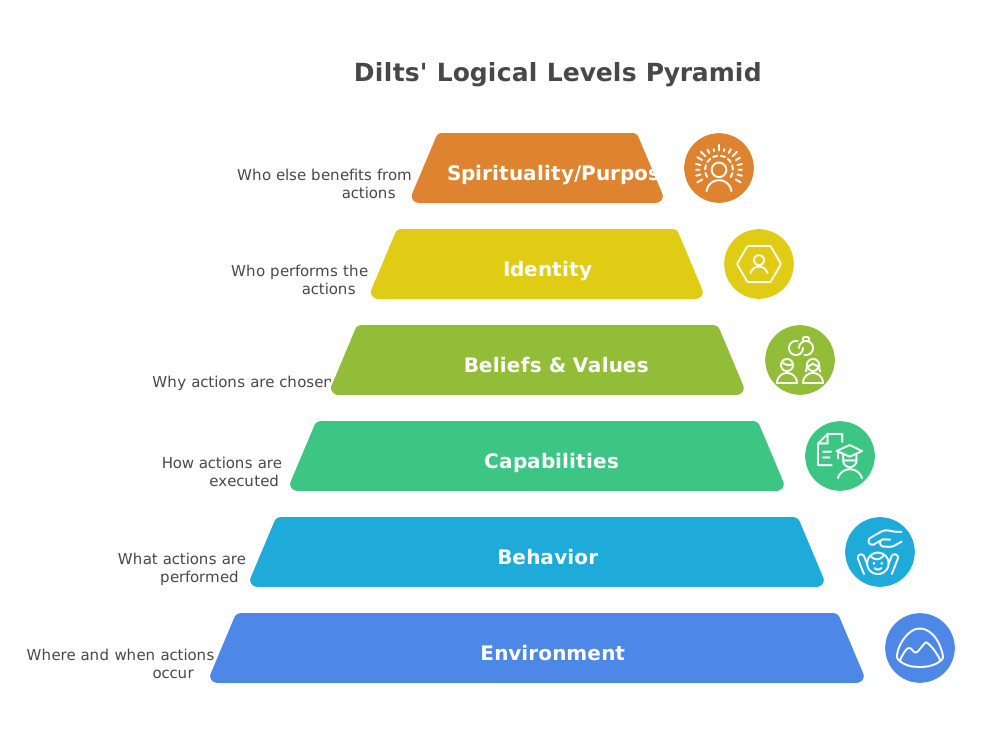
Level 1: Environment (Where & When)
This is the most superficial level. It’s the physical and virtual space where work happens—the office layout, the tools we use, the “beanbags and beer fridges.”
- The Trap: Most failed culture initiatives start and end here. Changing the environment is easy, but it has the least leverage.
- The Right Approach: Use the environment to support the culture you want, not to create it.
Level 2: Behaviors (What)
This level deals with people’s specific actions and work processes. It’s the “what” they do day-to-day.
- The Trap: Forcing new behaviors without changing the underlying mindset leads to “innovation theatre.”
- The Right Approach: Define and introduce clear behaviors that are consistent with an innovative mindset.
Level 3: Capabilities (How)
This level is about skills and competencies. It’s the “how” we do our work. This includes skills like Innovative Thinking, Design of Experiment and rapid prototyping.
- The Trap: Believing that a single training workshop will create an innovator. A skill is useless if the employee doesn’t have the permission or courage to use it.
- The Right Approach: Systematically build new capabilities across the organization. Invest in training, but it’s most effective when these new skills are applied within a well-defined innovation process that gives them context and purpose. See how to structure that process in our complete ISO 56001 Playbook.
Level 4: Beliefs & Values (Why)
This is the true heart of culture. It’s the “why” behind our actions. It’s what people believe to be true and what they hold as important.
- Beliefs: “My boss sees failure as a valuable learning opportunity,” versus “If my project fails, my career is at risk.”
- Values: “We value speed and learning,” versus “We value getting it right the first time.”
The Right Approach: This mindset shift from viewing failure as a cost to seeing it as a valuable investment in learning is critical for building a resilient innovation portfolio. It is a key part of the argument for proving the long-term, tangible ROI of your system. Learn how to frame this for your C-Suite in our guide to building a business case.
Level 5 & 6: Identity (Who) & Purpose (For Whom/What)
This is the deepest level of change. “Identity” is about our sense of self (“We are innovators”). “Purpose” connects that identity to a larger mission.
The Right Approach: Leaders must constantly articulate and reinforce a compelling vision of “who we are” and “why we exist.” This is the essence of being a ‘Future-Focused Leader’—using a deep understanding of future trends to shape a purpose that inspires action. Explore the tools leaders use, like Strategic Foresight, in our deep-dive guide.
Changing culture means starting from the top of the pyramid (Purpose, Identity, Beliefs) and working your way down, not the other way around.
Your Next Move
Changing deep-seated beliefs and mindsets is the most challenging and most rewarding work a leader can do. It goes beyond standard management techniques and into the realm of human psychology and communication.
This is where specialized knowledge in fields like Neuro-Linguistic Programming (NLP) becomes invaluable. For organizations serious about this transformation, our group company, Mindset Mastery Academy, provides specialized coaching and training based on powerful NLP models to equip your leaders with the skills needed to truly architect a culture of innovation from the inside out.