

This post is also available in:
 ไทย (Thai)
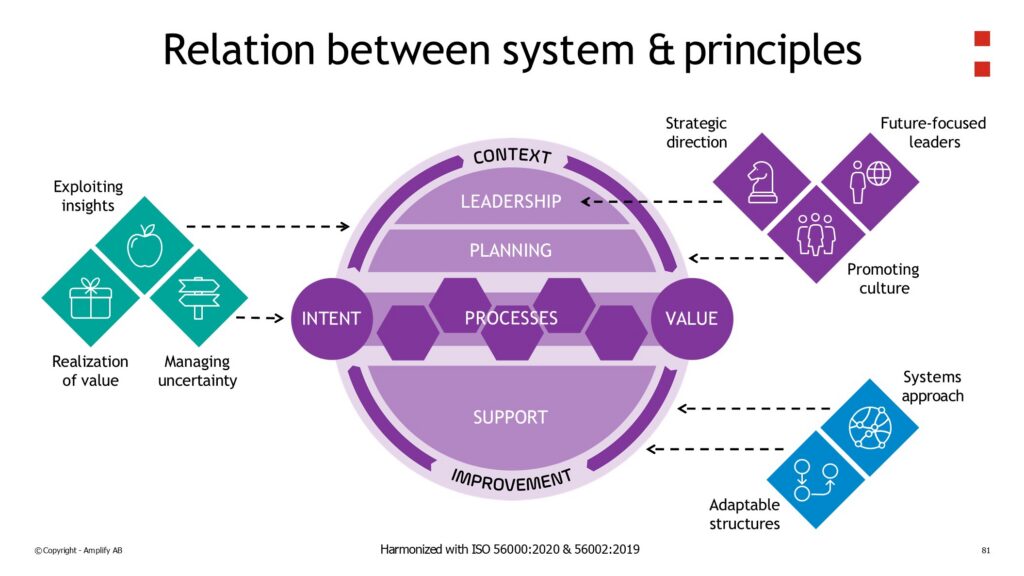
While a standard like ISO 56001 provides the “blueprint” for an Innovation Management System (IMS), the “DNA” that separates truly great innovators from the rest is defined by a core philosophy. That philosophy is codified in the ISO 56000 standard as eight essential principles that act as a compass for leaders.
Embracing these principles is not just a theoretical exercise; it has a direct impact on the bottom line. According to extensive research by McKinsey & Company, companies in the top quartile for innovation generate 2.4 times higher economic profit than their industry peers, proving that a systematic, principle-driven approach is a powerful engine for financial performance.
The difference between companies that lead their industries and those that lag behind often comes down to a single capability: innovation. But what truly separates the best from the rest? According to extensive research by McKinsey on the "eight essentials of innovation," the performance gap is widening. Top-quartile innovators now generate 2.4 times more economic profit than their industry peers.

The secret isn't random creativity; it's disciplined strategy. Elite innovators master the art of making tough resource-allocation choices, often ignoring generic formulas like the "70-20-10 rule" in favor of bold, concentrated bets. They establish strong governance to ensure promising projects are accelerated while underperforming ones are stopped, a process that gives only 24% of all executives confidence in their own companies. This systematic, principle-driven approach is what turns innovation from a cost center into a powerful engine for financial performance.
This guide will decode these eight principles to help you understand the core mindset of a world-class innovator.
Decoding the 8 Principles of Innovation DNA
1. Realization of Value
The first and most critical principle is that all innovation activities must be directed toward the ‘Realization of Value.’ This forces an organization to answer the question, “Why are we doing this?” before they begin. Innovation without tangible value—be it profit, customer delight, or social impact—is merely motion without progress.
Leadership Question: Can we articulate the clear, specific value of every major innovation project we are currently funding?
2. Future-Focused Leaders
Leaders in an innovative organization do more than manage the present; they dedicate real energy to “architecting the future.” They are the primary champions who see opportunity where others see risk, and who empower their teams to explore the unknown. This requires a systematic discipline in Strategic Foresight. To learn the methods leaders use to map the future, read our deep-dive guide here.
Leadership Question: Do our leaders spend more time talking about ‘future opportunities’ than ‘current problems’?
3. Strategic Direction
Successful innovation is not random; it is the result of deliberate choices that align with the organization’s overarching strategy. Every innovation project should be a clear answer to a strategic need, ensuring that all resources are focused on building a long-term competitive advantage.
Leadership Question: Can we draw a straight line from every major innovation project back to a core strategic company goal?
4. Culture
A brilliant process will always fail in a brittle culture. A culture that supports innovation is a safe environment that encourages curiosity, tolerates ambiguity, and, most importantly, treats “intelligent failures” as valuable learning assets. Building this requires more than just office perks. To learn how to create lasting cultural change by focusing on mindsets, see our leader’s guide here.
Leadership Question: When was the last time our organization celebrated a team for a ‘failure’ that produced a valuable lesson?
5. Exploiting Insights
Insights are the fuel for innovation. World-class organizations build systematic processes to capture signals from everywhere—unheard customer whispers, emerging technologies, market shifts, and employee ideas—and turn those observations into actionable opportunities.
Leadership Question: Do we have a systematic pathway for an unexpected insight to reach a key decision-maker?
6. Managing Uncertainty
Innovation is, by definition, uncertain. This principle is not about eliminating risk but about *managing* it intelligently. It’s about building a capability for rapid experimentation and learning, allowing teams to “fail smart” by testing ideas quickly and cheaply to navigate from a novel concept to a proven solution.
Leadership Question: Does our project approval process encourage ‘small, fast experiments,’ or does it demand a perfect plan from the very beginning?
7. Adaptability
The market is never static, so an IMS cannot be rigid. Organizations must be able to adapt their structures, processes, and priorities in a timely manner to seize new opportunities or counter emerging threats. Agility is the key to long-term resilience.
Leadership Question: How long does it take for us to officially stop a project that is no longer working? Weeks, months, or years?
8. Systems Approach
This final principle ties everything together. Innovation must be managed as a holistic system, not a series of siloed projects. This ensures that leadership, culture, strategy, and processes all work in concert towards the common goal of realizing value. A key part of this is integrating the innovation system with other systems, like Quality Management. Explore how ISO 56001 and ISO 9001 work in synergy here.
Leadership Question: Do our strategy, innovation, and operations teams work like a coordinated orchestra or like separate musicians playing their own tunes?
Your Next Move
Understanding these principles provides a new lens through which to view your organization. The most powerful next step is to use these questions as a diagnostic tool. Discuss them with your leadership team and perform a simple self-assessment: Which principle is our strongest? Which is our weakest? The answer will reveal the most critical area to focus on.
Facilitating this kind of strategic conversation is the core mission of our Elevate Your Leadership program, where we work with executive teams to turn these principles into a measurable action plan and a strong corporate culture.