

This post is also available in:
 ไทย (Thai)
In any successful organization, every significant initiative faces the same tough question from leadership: “What is the return on this investment?” An Innovation Management System (IMS) based on ISO 56001 is no exception. A certificate on the wall is not a business result.
To get buy-in, you must build a robust business case that moves beyond the process benefits and proves the tangible, financial value of the investment.
This guide provides a practical framework for doing just that. It’s designed to help you, the innovation leader, structure a compelling argument to present to your C-suite, focusing on the three areas they care about most: revenue growth, cost savings, and strategic advantage.
1. Frame the Conversation: From ‘Cost Center’ to ‘Value Engine’
Before presenting any numbers, you must frame the investment correctly. An IMS is not a cost of compliance; it is a capital investment in the company’s engine of future growth. The “cost” of ISO 56001 should not be compared to doing nothing. It should be compared to the immense cost of not having a systematic innovation capability: missed opportunities, wasted resources on failed projects, and the growing risk of market disruption.
2. The “Cost” Side: A Realistic Breakdown of the Investment
To build a credible case, you must present a transparent view of the required investment. Avoid giving a single number; instead, break it down into clear categories.
| Category | Example Items |
|---|---|
| Direct Costs (External, out-of-pocket expenses) |
|
| Indirect Costs (Internal investment of time and focus) |
|
- Direct Costs: These are the external, out-of-pocket expenses. This includes fees for the Certification Body and any expert implementation partners you engage to accelerate the process.
- Indirect Costs: This is the internal investment of your team’s time and focus. This is the most significant component, but it’s also the one that builds a permanent, internal capability.
3. The “Benefit” Side: The 3 Types of Tangible ROI
A world-class IMS delivers returns in three distinct ways. Your business case should articulate the potential value in all three areas.
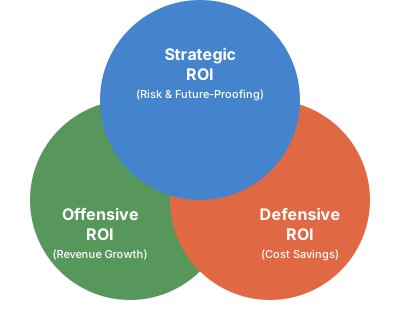
Type 1: Offensive ROI (Revenue Growth)
This is about playing offense and growing the top line. A systematic approach to innovation directly impacts revenue.
- How it works: An IMS creates reliable processes to find new opportunities, validate them with customers, and move them to market faster and more successfully.
- A landmark example of this is Procter & Gamble’s (P&G) “Connect + Develop” strategy. By creating a system to systematically source and integrate external innovations, P&G famously set a goal to have 50% of their new products come from outside the company. This strategic shift in their innovation system led to the launch of blockbuster products like the Swiffer and Olay Regenerist, adding billions in revenue and dramatically increasing their innovation ROI.
- Proxy Metrics to Use:
- Time-to-Market: How much faster can you launch new products?
- New Product Vitality Index: What percentage of total sales comes from products launched in the last 3-5 years?
- Win Rate: What is the success rate of new product launches?
Procter & Gamble (P&G) transformed its innovation strategy by embracing open innovation through its “Connect + Develop℠” initiative. Once known for its insular “not invented here” culture, P&G now actively seeks external ideas and technologies to accelerate product development and improve consumer lives. Over 50% of its innovations come from outside the company, supported by a global network of Technology Entrepreneurs and a dedicated innovation portal.

The company conducts proactive searches across countries and industries, identifying expertise that aligns with its strategic needs—from packaging and design to green technologies. Simultaneously, P&G receives over 300 unsolicited innovation submissions monthly via its website, with about 5% deemed of interest and potentially leading to collaboration.

With around 1,000 active contracts and a 40% repeat business rate, P&G views innovation partnerships as long-term relationships. It encourages potential collaborators to understand its brand portfolio, think strategically about complementary offerings, and use its online portal to connect with the right teams.

This approach has positioned P&G as a leading open innovation partner globally.
Type 2: Defensive ROI (Cost Savings & Efficiency)
This is about playing defense and protecting the bottom line. Structure and process reduce waste.
- How it works: An IMS eliminates redundant projects, allocates R&D resources more effectively, and improves the efficiency of development cycles.
- Proxy Metrics to Use:
- R&D Resource Allocation: What percentage of resources is spent on projects aligned with top-tier strategic goals?
- Project Kill Rate: How effectively does your process filter out weak ideas early, before significant resources are wasted? (A higher, faster kill rate is a good thing).
Type 3: Strategic ROI (Risk Mitigation & Future-Proofing)
This is the most important, C-level argument. It’s about ensuring the company’s long-term survival and relevance.
- How it works: An IMS is an insurance policy against disruption. It builds the organizational capability to sense changes in the market and adapt before it’s too late.
- How to Frame it:
- “This system mitigates the risk of a competitor surprising us with a new technology.”
- “It reduces our dependency on a single hit product by creating a reliable pipeline of future innovations.”
4. Tying “Soft” Benefits to “Hard” Problems
Your leadership team may be skeptical of qualitative benefits. Your job is to connect them directly to tangible business problems they already recognize.
- Instead of saying: “It will improve our innovation culture.”
- Say: “It will help us solve our high employee turnover in the R&D department by creating a more engaging and empowering work environment, reducing recruitment and retraining costs.”
- Instead of saying: “It will improve our processes.”
- Say: “It will create more predictable launch schedules, which will improve our sales forecasting accuracy and our relationship with key distribution partners.”
Your Next Move: Building the 1-Page Briefing
Using this framework, your next step is to create a powerful, one-page summary for your leadership team. Start by identifying the biggest strategic problems your IMS will solve (from Section 4), then map the potential returns using the three types of ROI.
To get the initial data needed for this business case, the most effective starting point is a formal Gap Analysis or Innovation Maturity Assessment. This provides the objective, data-driven baseline that is essential for building a credible argument for investment.
Many leaders find this initial diagnostic phase to be the most critical step in gaining executive support. To facilitate this, BOLD Group offers The BOLD Diagnosis™, our proprietary assessment service. It is specifically designed to rapidly benchmark your organization against the ISO 56001 framework, providing you with the precise data and strategic roadmap needed to complete your business case and begin your implementation journey with confidence.